Review of Heaven on Earth: A Journey Through Sharia Law from the Deserts of Ancient Arabia to the Streets of the Modern Muslim World,
Sadakat Kadri
New York: Farrar, Straus and Giroux, 2012
There are 50 Muslim-majority states in the world; 11 of them, including Egypt, have constitutions that acknowledge Islam as a source of national law. In Heaven on Earth, Sadakat Kadri, an English barrister and New York attorney, provides a much-needed and highly readable overview of Islamic legal history and an entertaining survey of the state of Islamic law today, full of fascinating anecdotes.
For instance, have you heard the one about the eleventh-century Sufi mystic whose prayers were interrupted by a familiar voice: "Oh, Abu Al-Hasan!" it boomed. "Do you want me to tell people what I know about your sins, so that they stone you to death?" "Oh, Lord," Al-Hasan whispered back. "Do you want me to tell people what I know about your mercy, so that none will ever feel obliged to bow down to you again?" "Keep your secret," came God's conspiratorial reply. "And I will keep mine."
Such risqué offerings aside, Kadri looks at the development of Islamic law from the time of the Prophet, focussing on attitudes to war, criminal justice, religious tolerance, and movements of reform through history. He provides valuable background for all those concerned and/or excited about today's resurgence of Islam. As the fastest growing religion, second only to Christianity in numbers (and surely first in terms of sincere practitioners), Islam is an increasingly powerful force not only in the world of religion, but in the realms of culture, politics and even economics.
Guided missives
Ard ard (Surface-to-surface): The story of a graffiti revolution
Sherif Abdel-Megid
Egyptian Association for Books 2011
ISBN 978-977-207-102-9
Graffiti -- the art of the masses, by the masses, for the masses -- has existed since ancient times, with examples dating back to ancient Greece, the Roman Empire, and arguably to Pharaonic Egypt. Sherif Abdel-Megid, a writer who works for Egyptian television, boasts that Egypt's revolution and the explosion of popular art that followed it finds its roots in the decay of the Sixth dynasty in Egypt's Old Kingdom, following the reign of Pepi II (2278-2184 BC), credited with having the longest reign of any monarch in history at 94 years (Mubarak, eat your heart out). His own decline paralleled the disintegration of the kingdom and it is thanks to Pharaonic graffiti that we know about it.
I confess that I cringe when I see the word “post-modern.” This word has
obscured more discussions, confused more gullible readers, and conned
more writers than any word since “existential” and its “-ism.” For the
most part, it has served as a kind of fashionable linguistic operator
that signals something radical and profound will follow. Almost always,
what follows disappoints.
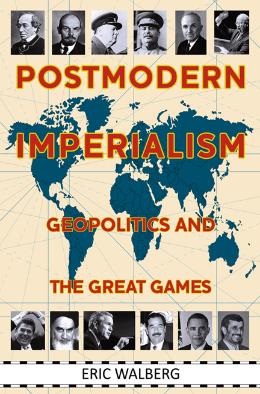
Eric Walberg’s book, Postmodern Imperialism (Clarity
Press, 2011), doesn’t change my general opinion of the word, though
what follows the title certainly doesn’t disappoint.
Walberg has
offered a welcome taxonomy of imperialism from its nineteenth century
genesis until today; he has given a plausible explanation of
imperialism’s contours since the exit of the Soviet Union and Eastern
European socialism from the world stage; and he has convincingly
described Israel’s unique role in the continuing reshaping of
imperialism’s grasp for world domination.
I. Let the Games Begin…Again…and Again
The great disaffected masses tell us that history is on the march and, as usual, guns and butter are the simpler issues. In America, support dwindles for a war that has lasted a decade. Drone missiles, each costing $100,000, kill “terrorists” in gutturally named, chicken-scratch places bewilderingly far from America’s hometowns, whose simple citizens ask where their taxes go. Costs of the Afghanistan war this year are the highest ever, $119.4 billion and counting.[1] Polls show historically deep disaffection with The System. The mask of America-First patriotism is falling, revealing an intoxicated self-grandiosity and will to power by renascent Bush-era neocons and cynical manipulations by the CEO caste and other one-percenters for more and more wealth, and whose sense of entitlement the victims of class warfare, lumpen proles and petit bourgeoisie alike, seem unable to stomach any longer.[2] Approval of the Republican led-by-gridlock Congress hovers around fifteen percent.[3] Ever-larger protests in other cities in America and internationally have extended those on Wall Street – protests even a year ago one would never have predicted – and “class warfare – rich against poor” appears on the protestors’ signs.
The disaffected might also ask why the US, as Eric Walberg notes in his extraordinary new book, has 730 American military bases in fifty countries around the globe, and why the US share of the world’s military expenditures is 42.8% while, by comparison, China’s is 7.3% and Russia’s 3.6%. The unavoidable irony is that the Pax Americana seems to be requiring endless war with no particular rationale behind it – and truly astonishing numbers of dollars are spent on behalf of war rather than at home. What may be fatally undermining credibility in America’s “transcendent values” has been the sense that as the facts filter down to the masses, the Empire’s new clothes appear to be the same as that of past empires. All empires have births and deaths – the US Empire will be no different. Internal contradictions of the US efforts to control the globe seem now to be sending things spiraling out of control.[4]
Eric Walberg’s acute insights into the contemporary global order raise many questions about the continued viability of the American and Israeli focus on wealth and power. Perhaps understandably, his interests and insights inspired by the Islamic world make him a penetrating commentator on peoples who are a product of Christian and Jewish tradition.
Walberg is a Canadian authority on the Middle East, Central Asia and Russia who writes for Al Ahram, the best known English language newspaper in the Middle East.
Though the number of
critical voices concerning Israel, Zionism and Jewish power is growing
steadily, a clear distinction can be made on the one hand between
contributors who operate within the discourse and are politically
oriented, and others who transcend themselves above and beyond any given
political paradigm.
The former category refers to writers and scholars who
operate 'within the box,' accepting the restrictive measures of a
given political and intellectual discourse. A thinker who operates
within such a framework would initially identify the boundaries of the
discourse, and then shape his or her ideas to fit in accordingly. The
latter category refers to a far more challenging intellectual attempt:
it includes those very few who operate within a post-political realm,
those who defy the dictatorship of 'political-correctness', or any given
'party-line'. It relates to those minds that think 'out of the box'.
And it is actually those who, like artists, plant the seeds of a
possible conceptual and consciousness shift.
The Wandering Who? A study of Jewish identity politics, gives a unique insider’s view of the Israeli mind. Its author explains to Eric Walberg that you can take the girl out of Jezebel, but you can’t take Jezebel out of the girl
Gilad Atzmon is a world citizen who calls London his home. He was born a sabra, and served as a paramedic in the Israeli Defense Forces during the 1982 Lebanon War, when he realised that “I was part of a colonial state, the result of plundering and ethnic cleansing.” He has wandered far since then, become a novelist, philosopher, one of the world’s best jazz saxophonists, and at the same time, one of the staunchest supporters of the Palestinian cause, supporting their right of return and the one-state solution. He now defines himself as a “proud self-hating Jew” and “a Hebrew-speaking Palestinian”. In 2009 Turkish Prime Minister Recep Tayyip Erdogan quoted Atzmon during a debate with Israeli president Shimon Peres, telling him at the World Economic Forum that “Israeli barbarity is far beyond even ordinary cruelty.”
Three books recently published by the American radical publisher Clarity Press reflect different aspects of racism in the US, which even under a black president is unfortunately alive and well, promoted in US policy at home and abroad -- if not officially:
Devon Mihesua, American Indians: Stereotypes and Realities
Stephen Sheehi, Islamophobia: The Ideological Campaign Against Muslims
Francis Boyle, The Palestinian Right of Return Under International Law
-secular thinkers imagine they have
left religion behind, but have only exchanged religion for a humanist faith in
progress
-Joseph Roth worried about spread of
ideas of national self-determination. Monarchy was more tolerant. A society can
be civilized without recognizing rights, while one based on rights may be
tainted with barbarism (Austria-Hungary
abolished torture in 1776)
-torture is Enlightenment tradition,
'progress' a legacy of Christianity (salvation in battle between good and evil
Zoroastra). 'God defeats evil' translated into secular terms. also meliorism of
liberal humanists. Enlightenment hostile to Christianity but used Christian
framework.
-US enriched rather than impoverished
by the two world wars and by their outcome, nothing in common with Britain -> still glorifies military, sentiment
familiar in Europe before 1945.
-in Europe,
dominant sentiment relief at "final closing of a long, unhappy chapter"
vs in US - story recorded in a triumphalist key. war works. thus remains
the first option, vs last resort
-20th c rise and fall of the state. welfare
state a cross-party 20th c consensus implemented by liberals or conservatives
not as first stage of 20th c socialism but culmination of late-19th c reformist
liberalism, prerequisites of a stable civil order. p10
-citizens lost gnawing sentiment of
insecurity and fear that had dominated political life between 1914 and 1945. forgot
this fear -> neoliberalism. now fear reemerging [-> neofascism], fear
that not only we but those 'in authority' have lost control of forces beyond
their reach [implicitly acknowledging the cabal of international bankers/ military
industrial complex (mic) that conspire above governments, tho Judt would be the
first to dismiss this p20]
Clarity Press June 2011
advanced purchase http://www.claritypress.com/Walberg.html
PREFACE
To young people today,
the world as a global village appears as a given, a ready-made order, as if
human evolution all along was logically moving towards our high-tech,
market-driven society, dominated by the wealthy United States. To bring the
world to order, the US must bear the burden of oversize defense spending,
capture terrorists, eliminate dictators, and warn ungrateful nations like China
and Russia to adjust their policies so as not to hinder the US in its
altruistic mission civilatrice.
The reality is something
else entirely, the only truth in the above characterization being the
overwhelming military dominance of the US in the world today. The US itself is
the source of much of the world’s terrorism, its 1.6 million troops in over a
thousand bases around the world the most egregious terrorists, leaving the
Osama bin Ladens in the shade, and other lesser critics of US policies worried
about their job prospects.
My own realization of
the true nature of the world order began with my journey to England to study
economics at Cambridge University in September 1973. I decided to take the
luxury SS France ocean liner which offered a student rate of a few hundred
dollars (and unlimited luggage), where I met American students on Marshall and
Rhodes scholarships (I had the less prestigious Mackenzie King scholarship),
and used my wiles to enjoy the perks of first class. The ship was a microcosm
of society, a benign one. The world was my oyster and I wanted to share my joy
with everyone.
But I was in for a
shock.
How green is your deen?
Green Deen: What Islam Teaches about Protecting the Planet, Ibrahim Abdul-Matin, San Francisco CA: Berrett-Koehler, 2010
Muslim Americans are slowly beginning to make their mark on their very conflicted society. There are more Muslims than Jews in the US now -- approximately 5 million. They are the most diverse of all American believers, 35 per cent born in the US (25 per cent Afro-American), the rest -- immigrants from southeast Asia, Africa and the Middle East. Traditionally they have voted Republican, but have shifted to Democrat and Green parties in recent years.
Three new publications from the leading radical British press are the tip of a growing iceberg of passionate pleas for sanity in international affairs. Most of us prefer to stick our heads in the sand as the world goes to hell in a hand-basket, but there are works that can fascinate and uplift, perhaps even inspire us to do something before it is too late.
-the attempt to fuse the public and private lies behind Plato’s attempt to answer the q “Why is it in one’s interest to be just?” and Christianity’s claim that perfect self-realization can be attained through service to others. [capitalism proposes the invisible hand, soc – class consciousness and state-sanctioned ideology, Rorty’s vision – soc demo and metaphors]
-ecology - 19th c term - investigation of interrelationships between animals, plants, and their inorganic environment - dynamic balance of nature, interdependence of living and nonliving things. vs environmentalism (natural engineering)
-social ecology - dialectical unfolding of life-forms from simple to complex. (history of phenomenon is the phenomenon itself) human-made universe is 'second nature'. society = institutionalized communities. philosophy of evolution. must synthesize these 2 natures into a 3rd. process of achieving wholeness by means of unity thru diversity, complementarity (vs homogeneous monocultural oneness of cap).
-x preferred schoolgirls because less complicated, less real than adult women, as dream less complicated than reality.
paradox of sex - always seems to be offering more than it can deliver.
Time and its discontents
-Latin words for culture = agriculture/ domestication AND translation from Greek terms for spatial image of time. We are 'time-binders', creating a symbolic class of life, an artificial world -> control over nature. Time becomes real because it has consequences. Flow of time 'the distinction between what one needs and what one has, the incipience of regret' (Guyau (1890) Carpe diem, but civ(ilization) forces us to mortgage the present to the future.
-worldatlarge dangerous and threatening. It didn't like the Jews (Js) because they were clever, quick-witted, successful, but also because they were noisy and push. It didn't like what we were doing here in the Land of Israel either, because it begrudged us even this meager strip of marshland, boulders, and desert. Out there in the world all the walls were covered with graffiti: yids, go back to Palestine, so we came back to Palestine and now the worldatlarge shouts at us: Yids, get out of Palestine.
25/12/8 This latest collection of essays by the controversial Israeli writer will not disappoint both admirers and antagonists of this iconoclastic anti-Zionist, most definitely the greatest thorn in Israel's very own backyard. Shamir has known controversy most of his life, notably when he was forced to leave the Soviet Union for demonstrating defiantly against the Soviet occupation of Czechoslovakia. He came to Israel, served as a paratrooper in the Israeli army, before settling down to a career as journalist (Haaretz, BBC), translator (James Joyce, the Caballah), and increasingly a one-man Internet David to Israel's Goliath. He has never looked back, despite the difficulty of publishing his unapologetic critiques of not just Zionism and Israel, but of Judaism, Jews and Jewry.
[draft of upcoming book]
One World: 20th century conspiracies
Eric Walberg
Introduction - From 9/11 1973 to 9/11 2001
In Canada, dinner time chat – left or right – about world events generally follows the standard media script: the backward Muslims must be taught a lesson, that the events of 9/11/2001 and the tragedies unfolding in Iraq and Afghanistan are at worst a cock-up on the part of the US government and friends. Something like the following is served up on both sides of the political spectrum: "They had to invade Afghanistan to stop the Taliban supporting Al-Qaeda. Invading Iraq was a mistake but what do you expect from a moron like Bush? If only he'd listened to his father and just kept chipping away at Saddam."
In Egypt, the idea that the bombing of the twin towers on 9/11 was the work of a handful of Muslim fanatics directed by Osama bin Laden is dismissed by all but a few westernized folk. "Bush bombed them to launch his war against Islam and to steal Iraq's oil," is the usual response. Or, "9/11 was done by a group within the US government in league with Mossad, using Muslims (or at least their passports) as a front."
Where is the truth? We all agree 9/11 was a conspiracy, but by whom? Is it possible that the official conspiracy theory is a hoax covering a much more frightening cabal?
Film script: The Silk Road and the unknown East -- 6 part documentary
Eric Walberg
Introduction and Part I
We will take a journey along the most ancient and thrilling road in Man's history, through a mysterious and little known part of the world, but one which has experienced all there is - the great religions have all thrived here at one time or another - Buddhism, Judaism, Christianity, Islam; at certain periods great centres of learning and the arts sprang up and declined, as did great warrior-princes. It is a region of violent contrasts - desert, mountains, lush valleys and oases. It is a mix of many races. Until a century ago, it was all but lost to the march of civilisation. Until the fall of Communism, it maintained its shroud of secrecy. With modern means of communications, it is now as accessible as any other destination. I am speaking of course of where East truly meets West - Central Asia.
We left Saturday morning for a 4-day hike. Because of the growing problem of bandits in the mountains, Sasha decided to start from the mountains nearest to Tashkent which start from a Tajik village (all villages near or in the mountains are populated by either Tajik or Kazakh) called Nevichu, avoiding check points by taking back roads. Sasha’s wife, Oksana, (whom I met on the plane from New York to Tashkent when she conned me into taking one of her 50-lb. bags to avoid extra baggage charges) saw Sasha, their son, Dima, and myself off, agreeing to meet us 5 days later in Gazalkent.
A secondary city
-sunrise, sunset - vacant metaphors, eroded figures of speech, ghosts in the attic? God embedded in the childhood of rational speech (Nietzsche)
-speech communicating meaning and feeling => God's presence, esp. aesthetic meaning
-when we encounter text/ art/ music (tam), i.e., the other in its condition of freedom, we find transcendence
-enigma of creation is made sensible in text, art music (tam)
-interpreter - decipherer and communicator of meanings, translator between languages/ cultures/ conventions, and executant, giving intelligible life to tam
-private reader/ listener can become executant of felt meaning when learns by heart, affording the music indwelling clarity and life-force, ingests (not consumes)
Roots of one's pleasures and emotions:
Chinese eye - sees nature as having its own life, untamed
Persian heart - romantic love
African ear - music
Mongol nomadic sense of freedom
-must search further than ancestors for roots of freedom and to understand emotions and ambitions
Man is faced with basic loneliness
-immunity from loneliness using loneliness as vaccine via:
1/ hermit - professional alien to seek internal peace
2/ turn inwards
3/ awareness of the absurd - be an eccentric
4/ sense that individual contains echoes of the incomprehensible coherence/ order of the world, has divine spark, recognise a link of generosity between themselves and others, rational and emotional connections which mean that they are part of a wider whole, which leads to altruism
-diminish FEAR of being alone: only then can one relate to others on terms of mutual respect
-goodness of a natural trait is province of ethical reasoning
-Darwin 1/ species related by sharing descent from common ancestors (unity of life), 2/ species change thru natural selection, 3/ male/female (m/f) obey universal templates -- males 'ardent' and f 'coy' (choose mate for superior genes, ie, best male vs best match).
-social selection - animals exchange help in return for access to reproductive opportunity, mutual assistance with reproductive opportunity as currency. social-inclusionary traits among f, or among m and shown by secondary sex characteristics (evolutionary approach to social behaviour)
-human development characterised by cooperation
The care of the self
Artemidorus The interpretation of dreams
-break down dream into constituent partts, decipher in context of the whole
-virtuous vs. ordinary individual - gods speak to former
-the more you understand dreams, the more complex they become (to hide behind images)
-wasting sperm is bad (with prostitute, fellatio - signifying loss of money), being passive is bad for man (tho sex with slaves or passive with older man is ok, the latter a promise of gifts)
-sex out of harmony with nature is bad - rift, enmity, death
-Jenifer Hart's pragmatic approach to Jacob's churchgoing is utilitarian - actions not intrinsically good or evil, but should be judge by their consequences. Right acts produce best results. 1960s loss of religious faith but while people were casting off the trammels of institutional Christianity, they were also turning to alternative forms of faith. 'Go with the flow' antithesis of ideals of convent but both seeking what gave life intrinsic value, rejecting money and worldly success. Transcendental meditation to change thought structures; spirituality and rituals bring measure of peace, help transform, release from bind of ego.
The 4 main ways that the mind works are sensation/thinking and feeling /intuition - the former more the realm of the conscious (c - rational), the latter of the unconscious (u - nonrational)
Thinking and feeling are categories of perception; intuition and sensation of apprehension
c (shadow + anima) + c (ego) = Self.
The unconscious (u) is compensatory/complementary to the conscious (c).
The general theme: respect your child’s feelings, let the child develop and mature to become independent, love unconditionally. Parents, especially mothers, unconsciously or otherwise, use the child to fulfill their needs, and use conditional love as their weapon (rationalized as ‘socialization’) A child who resists is rejected or withdrawn from and can’t help but re-enact the relationship. There is no clear separation of subject/object (child’s fear that rejection of object will destroy it).