The
massacre in peaceful Oslo was a replay of this earlier horror in
reverse – no longer the Jews as victims but as the inspiration of terror
against non-Jews – as Israel extends its wars not only to Greek ports
and French airports but to Norwegian children’s camps, complete with
rabbinical blessings for the murderers, notes Eric Walberg
Norway
is in a state of total shock after the 22 July car bombing in Oslo
killing seven, followed by the shooting spree at a Labour Party youth
camp on Utoya Island killing 69. This terrorist operation,
the worst massacre in Norway’s recent history, represents a greater
loss proportional to its five million people than 9/11 did to the US.
Speaking of which, an initial report in the New York Times, Wall Street Journal, Guardian,
et al attributed the attack to Islamists (resentful of Norway’s
democracy, etc), “a terror group, Ansar al-Jihad al-Alami, or the
Helpers of the Global Jihad”.
This was according to Dr William
McCants, a “terrorism analyst at CNA, a research institute that studies
terrorism”, author of a terrorist watchdog blog jihadica.com. CNA is too obscure to be found on the web, and expert McCants quickly retracted his claim. The NYT
later admitted Global Jihad may not even exist (let alone CNA), but who
reads the fine print in subsequent editions or checks if various
“organisations” are actually
fronts for something much more sinister, as long as it’s a question of
“Islamists”?
Perhaps CNA is a typo, for McCants’s feint is a
classic CIA media move targeting the current “enemy”, which worked in
spades, dominating the world’s mainstream media coverage of the
massacre. When exposed, McCants launched a new anti-Muslim angle
immediately, noting that the perpetrator, Anders Behring Breivik,
admires Al-Qaeda: “Just like Jihadi warriors are the plum tree of the
Ummah, we will be the plum tree for Europe and for Christianity,”
Breivik apparently wrote. That the world has the CIA and the McCants to
thank for the creation and promotion of Al-Qaeda in the first place does
not faze the zealous professor of terrorism. Even when Al-Qaeda is not
guilty, it is still guilty.
Breivik is a self-styled Christian
Zionist and Freemason, a “martyr” and “resistance fighter” in a “civil
war” against the “Marxist-Islamist
alliance” taking over Europe, according to his 1,500 page screed signed
“Knights Templar Europe”, available on the internet.
He
described members of Norway’s Labour Party as “traitors” like the
Norwegian collaborators in WWII because of their alleged support of
“multiculturalism and Islamisation” and criticism of Israel, in line
with Harvard lawyer Alan Dershowitz’s recent charges against the
“Quisling” Norwegian government. Breivik advocates “terror” attacks on
mosques, especially during Muslim religious holidays, intended to
“trigger Muslim riots” and allowing a rightwing “coup”. The holy month
of Ramadan begins 1 August.
Breivik epitomises the new Euro
right, which is both fanatically pro-Israel and anti-Muslim. Breivik
even approves of a Caliphate for Muslims, as long as it is in the Middle
East. This is similar to Hitler’s desire to push Jews out of Europe
into their own Jewish state in Palestine,
as Zionist collaboration with the Nazis in the 1930--40s makes clear.
But Euro neo-Nazism has the startling characteristic of being
pro-Jewish, and wishes not to rid Europe of Jews, but of Muslims. If
this requires terrorising and even killing a few million in the process,
that is a price worth paying to make Europe pure again.
How did
this eerie transformation of fascism -- from targeting Jews to taking
them as allies against Muslims -- come about? It is a combination of two
factors that have been fermenting in the post-WWII period.
The
origins of European Islamophobia lie in anxiety about and hatred felt by
many Europeans of their own European “other”, namely European Jewry.
Pre-WWII Europe feared a Jewish conspiracy to subvert Christian society.
In the post-Holocaust era, this has been displaced onto Muslim
immigrants, even by the traditionally anti-Jewish far right such as Le
Pen’s National Front, the British National Party and
Norway’s own Progress Party which are now Zionist and racist at the
same time.
With the rise of a Jewish state far from Europe,
which attracted many European Jews, unease about the “alien” other
momentarily abated. Jews who remained in Europe had lost their former
high profile as media owners, entertainers and industrial magnates, and
were now mostly invisible, there no longer being Jewish ghettos in the
major cities. Christianity accepted Judaism as its honoured ancestor, no
longer a threat or heresy requiring proselytising and/ or restrictions
on Jews. The 1950-60s saw a European flowering without either Jews or
Muslims having much of a profile.
The new “Judeo-Christian”
culture of the West (a concept dismissed by serious Christian and Jewish
scholars) is supposedly a happy family. Though Islam and Christianity
have much more in common, the rescue of millions of Jews from the Nazis
created a cultural bond between the former
hostile religions. Because the Jewish state in Palestine was created on
the dead bodies of Muslims, this cemented the present alliance of
Judaism and Christianity against Islam, a war supposedly of cultures,
but one rooted in Jewish imperial conquest in Palestine and
“Judeo-Christian” cultural hegemony in the West.
But as Europe’s
population began to age, by the 1970s the need for cheap labour forced
Europe to “import” Muslims, who are close religious cousins of
Christians but maintain pre-capitalists traditions. For instance, Muslim
women tend to wear veils, and thriving communities of believers need
new mosques with their non-European minarets.
While these
differences are hardly threatening, they are visible, and Muslims make good
(cheap) electoral fodder as scapegoats for the real culprits for the
mounting economic problems facing Europe – their very own Christian and
Jewish elites using banking crises and neoliberalism to cut living
standards.
As the empire wrestles to subdue Islam, its major
politico-cultural rival after the collapse of Communism, Islamophobia,
like anti-Communism has become rampant. Such bigots as Holland’s Geert
Wilders are working to form a Europe-wide International Freedom
Alliance, even including the US and Canada; an “Atlanticist
Islamophobistan”, according to analyst Pepe Escobar. Considering that
Muslims make up less than two per cent of US and Canadian populations,
this leads to “the surrealist American phenomenon of Islamophobia
without Muslims”.
Muslims indeed pose a threat to both the
Zionised Christians like Breivik and the Zionised Jews promoting the
expansion of Israel throughout Palestine. But for the rest of us, the
real threat is Zionism and Israel. The inspiration behind Breivik’s
horrendous deed is in the first place Israel, where the Bible says Jews
should congregate to await the endtimes. Breivik: “The time has
come to stop the stupid support of the Palestinians...and to start
supporting our cultural cousins -- Israel.”
His murders even have
a kind of rabbinical blessing. In 2009 Rabbi Yitzhak Shapiro of the
(illegal) West Bank settlement Yitzhar published The King’s Torah, which
condones killing even babies and children if they pose a threat to the
nation. “It is permissible to kill the Righteous among Nations even if
they are not responsible for the threatening situation,” he wrote. By
analogy, it is fine for such as Breivik to kill innocent fellow
Norwegians, Muslim and non-Muslim alike, if they threat his vision of a
pure Norway. Writes ex-Israeli Gilad Atzmon, “Breivik treated his fellow
countrymen in the same way that the IDF treats Palestinians.”
Breivik
no doubt noted Israel’s unpunished 2009 massacre in Gaza, an
action that coincided with the beginning of his plans to terrorise his
fellow Norwegians. He is surely aware
that plucky Israel is now fighting a rear-guard action against the
growing boycott, divest and sanctions (BDS) movement in Europe, which
prompted Israel – just days before the tragedy -- to pass a “herem” law,
threatening to sue anyone boycotting its products.
Europe’s BDS movement is in fact spearheaded by Norway. Two days before Breivik’s massacre, the 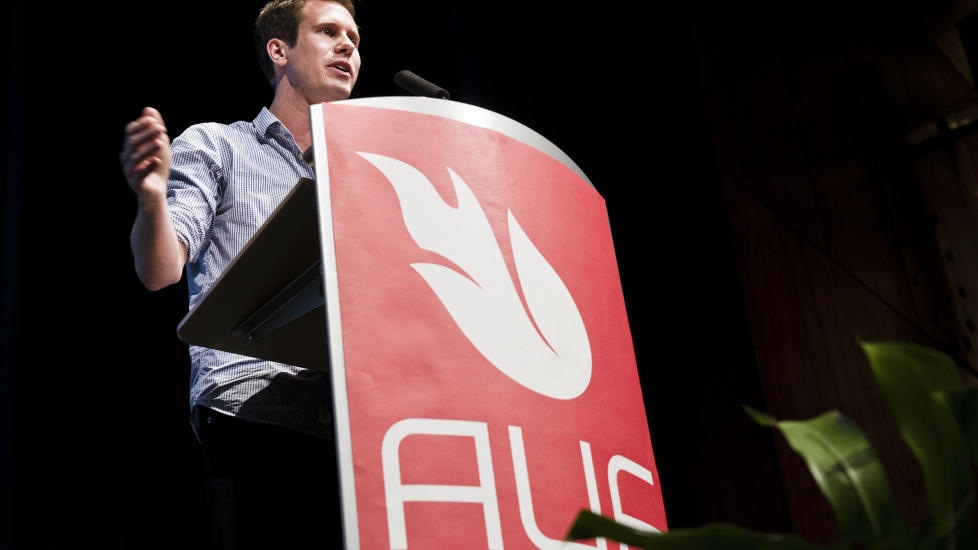 widely read Dagbladet tabloid
quoted Labour Party youth movement leader Eskil Pedersen as stating
that he “believes the time has come for more drastic measures against
Israel, and [that he] wants the Foreign Minister to impose an economic
boycott against the country.”
widely read Dagbladet tabloid
quoted Labour Party youth movement leader Eskil Pedersen as stating
that he “believes the time has come for more drastic measures against
Israel, and [that he] wants the Foreign Minister to impose an economic
boycott against the country.”
Two days before the massacre, Joseph Klein complained on Dershowitz’s FrontPageMag.com
about “The Quislings of Norway ... Norway is effectively under the
occupation of anti-Semitic leftists and radical Muslims, and appears
willing to help enable the destruction of the Jewish state of Israel.”
Breivik was a regular poster at document.no,
run by Jewish pro-Zionist Hans Rustad, which warns against
“Islamisation”, violence, and other social problems Rustad assumes to be
connected with Muslim immigration. According to Atzmon, such Euro blogs
“are almost exclusively focused on ‘the problem of Islam’, and on
Muslim migrants, all the while relentlessly propounding a
propagandistic Zionist agenda”.
Stephan Kramer, general secretary
of the Central Council of Jews in Germany, dismissed the pro-Israeli
tilt of the likes of Breivik as just skin-deep, used by them to mask
their inherent racism. US President Barack Obama dismissed the tragedy
as “domestic”. Israeli Prime Minister Benjamin Netanyahu turned the
tragedy on its head
and said Israel “completely
identifies” with the suffering.
Netanyahu’s compatriots at the Israeli Hebrew language blog rotter.net
were more honest: “Oslo criminals paid”; “It’s stupidity and evil not
to desire death for those who call to boycott Israel”; “To cry about it?
Come on. We Jews are not Christians. In the Jewish religion there is no
obligation to love or mourn for the enemy.”
While not going that far, Ynet
journalist Manfred Gerstenfeld complains about Norway’s “obsession”
with Israel as opposed to, say, Russia. He exhorted the Norwegians to
learn from “how Israel reacts to such events”. “How to defend oneself
against [terror] is an issue that almost by nature draws in references
to precedents from Israel,” he said proudly.
But it’s Israel’s criminal activity that inspired the killer. And why must we follow in Israel’s
security-obsessed footsteps, making our lives a living hell so that Israel can continue to perpetrate its crimes unpunished?
Breivik
boasts he is part of a shadowy network of latter-day crusader knights
set up in London in 2002 with cells across Europe, clearly inspired by
Israel. It is thus urgent that Western intelligence agencies investigate
Israeli and Zionist operatives before this new campaign of terror takes
hold.
Behind Norway’s Kristallnacht
- Written by Eric Walberg Эрик Вальберг/ Уолберг إيريك والبرغ