Western media always welcomes the overthrow of a dictator -- great headline news -- but this instance was greeted with less than euphoria by Western -- especially American -- leaders, who tried to soft-peddle it much as did official Egyptian media till the leader fled the palace. Egypt's president Hosni Mubarak was a generously paid ally for the US in its Middle East policy of protecting Israel, and the hesitancy of the Western -- especially US -- governments in supporting fully what should have been a poster-child of much-touted US ideals was both frustrating and highly instructive.
Canadian
government support for Mubarak was even more staunch until
vice-president
Omar Suleiman’s 20 second resignation speech 11 February, clearly
written with a metaphorical gun to one or both of their heads. This
craven loyalty to an autocrat reviled by his people was the US-Israeli
preferred solution. Much better to cool the passionate revolutionaries,
allow the system, so beneficial to Israel, to adjust and survive.
But
perhaps more important, much better to continue Egypt’s
state-of-emergency laws that allow the regime to keep Israel critics and
devout Muslims under raps, and just as important, allow the US to
“render” undesirable Muslims there to be tortured. Imagine if the
records of these renditions over the past decade by the US (and Canada)
to Egypt were to come to light, falling into the hands of the
revolutionaries, much like Britain’s secret treaties in WWI fell into
the Bolsheviks’ hands?
“They’re not going to put the toothpaste back in the tube,” quipped Canadian Prime Minister Stephen
Harper glumly. He could well be articulating -- in his own
tasteless way -- the sentiments of the Egyptian military establishment,
which had no use for a Mubarak dynasty and sided with the rebels, though
at a considerable cost. Those now in power, nominally headed by
Minister of Defence and Commander in Chief of the Armed Forces
Mohammed Tantawi, must push determined demonstrators out of Tahrir
Square, get people back to work, shut down further strikes, and keep
their US military advisers (not to mention the US president himself)
assured that the centrepiece of Egyptian foreign policy remains in
place. Truly a messy task.
It is hard to believe now that just a
few weeks ago, Mubarak was invincible, his visage gracing at least one
page in every newspaper every day, meeting with some Western leader,
posing with Israeli notables, confident that he was in control of his
desert ship-of-state. After the initial euphoria, and as evidence of his
misrule
and the perilous state that he left Egypt in pours out of newly
liberated media, people are overwhelmed, irritable and depressed. People
have undergone a wrenching shift in their thinking in the past three
weeks.
Iranian leaders note the eerie coincidence with their own
revolution of 11 February 1979 overthrowing the shah (1941-79). A
national holiday, more than half the population of Iran was out on the streets celebrating along with Egyptians when Mubarak finally resigned last Friday evening. US commentators prefer to compare the revolution to the overthrow of Philippines president Ferdinand Marcos (1965-87) and Indonesian president Suharto (1968-98). They even suggest it could lead to another Iranian revolution.
Despite the many differences, Iran and Indonesia
are the closest parallels: an anti-colonial revolt against a repressive
pseudo-Muslim autocrat whose corruption and nepotism undid him. Those
revolts triumphed when the army and
police gave up supporting the US-backed leader, much as Egypt’s
security apparatus did. The long repressed Muslim Brotherhood
is the Sunni equivalent of the Iranian clerics. Even if the US can
steer Egypt into the secular Indonesian model, it will still have to
come to terms with the fact that Indonesia does not recognise Israel,
that any future Egyptian government will almost surely renegotiate the
1979 peace agreement with Israel.
It seems that Egypt’s suffering
and oppression are something alien to Western experience. But this is
far from the truth. As the fervour spread like wildfire during the first
few weeks, I recalled how the leftist community in Toronto is just as
self-righteous and eager for change, how neoliberalism has left Canadian
society with yawning income disparities not much different than those
of Egypt. The most obvious difference being that the general standard of
living in Canada is higher and the middle class (still)
more numerous. But the very idea of such a spectacular event as
happened here to address issues of social justice is impossible to
imagine there or in the US.
It struck me that the most stark and
instructive parallel is not with Indonesia or Iran, but between
pre-revolution Egypt and the current US, which, like Egypt, has reached
the end of the same gruelling 30-year neoliberal road that Egypt did
under Mubarak’s reign, jettisoning any pretense of a just society. The
coincidences abound: both the US and Egypt began their ill-fated
journeys in that very 1981, with the ascendancy of US president Ronald
Reagan and the assassination of Egyptian president Anwar El-Sadat,
though El-Sadat had actually pre-empted Reaganomics with his infitah, dismantling much of Egypt’s socialism.
Each
US presidency since then has either embraced or been pressured by the
exigencies of capitalism and electoral democracy to enact greater and
great
tax cuts for the wealthy and corporations, meanwhile cutting social
services and increasing spending on so-called defence. Each "new"
government has regularly flouted the consensus of the electorate on all
major issues, from the environment, social services, jobs, to weapons
production, invasions, drug laws and the Cubas and Irans which in
defiance dare to flout the empire.
Income disparity is arguably the strongest impulse to revolt. As measured by the Gini coefficient (0 is perfect equality) Egypt stands in a far better light at .34 than the US .45 (Canada is .32).
So why did Egyptians succeed spectacularly where Americans -- in even greater need of a revolution -- 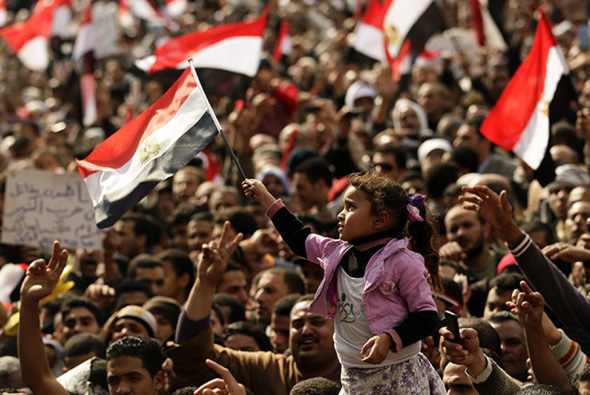 fail spectacularly?
Egyptians
seem to be much more politically astute than their American
counterparts, more willing to admit that their leaders take bribes, lie,
follow policies dictated by business or lobbies and which counter
public opinion.
But the key to
understanding why a revolution like Egypt's is impossible in the US is
the fact that, unlike Egypt's army (composed mostly of conscripts), the
US has a mercenary (excuse me, professional) army, which would have
little compunction to fire on any group threatening the sanctity of the
political establishment. Conscription
is a vital brick in building a democratic society, an safeguard
allowing the society to be dismantled if it turns into a jail or a
brothel, a brick which has been lost to the US and its satellites. A
brick that Egyptian protesters used to telling effect.
Senator John Kerry
said that the Egyptian people “have made clear they will settle for
nothing less than greater democracy and more economic opportunities”. So
what are Egypt's prospects of creating a thriving democracy? They would
be wise to listen to Kerry and to observe the US system, though not to
copy it but on the contrary to learn from its sorry state.
Why
would
Americans expect a president to be fair and hear them when he must
raise a billion dollars from corporations to outspend his equally
compromised rival in elections? New York Times analyst Bob Herbert
looked enviously at Egyptians’ longing for democracy, comparing the US
political system to a “perversion of democracy”, bemoaning that at the
very moment Egyptians are discovering it, “Americans are in the
mind-bogglingly self-destructive process of letting a real democracy
slip away.”
And yet Americans blissfully pledge their allegiance,
weep on 4 July and during presidential inaugurations, despite the
unassailable evidence of the injustices both domestically and abroad of
the system they live under. Egyptians, though just as nationalistic,
were able to see through the facade of their pseudo-democracy and rise
up to overthrow the guilty parties. They are the heroes of all true
democrats in the world. The few people particularly in
North America who see through their own quite transparent political facade can only look on wistfully.
What
became the anthem of the revolution — “Why?” by Mohamed Munir — was
written, presciently, a month before the 25 January spark that burned
away (let’s hope) much of the chaff accumulated during 30 years of
neoliberal “reforms”. He cries out to his homeland like a spurned lover
who vows to take his country back from the usurpers:
If love of you was my choice
My heart would long ago have changed you for another
But I vow I will continue to change your life for the better
Till you are content with me.
How
different from the equivalent American song — Bruce Springsteen’s “Born
in the USA” — self-pitying and hopeless in this, the world’s sole
superpower:
You end up like a dog that’s been beat too much
‘Till you spend half your life just covering up.